
The Mistake Almost Everyone Makes First
Someone backs into the garage door, or a storm sends a branch into it, and the first thing that happens is one spouse walks up, presses on the dent with their palm, and announces a verdict. "It's fine, just cosmetic." Or the opposite: "That's it, we need a whole new door." It's tempting because it's free, it takes ten seconds, and it feels like enough information to settle things. It isn't. Pressing on a panel tells you whether the metal flexes under your hand. It tells you nothing about what's happening behind that panel at the hinge, the track, or the strut that actually holds the door together. A dent's size is the least useful thing about it. Its location and what it's doing to the door's movement are what actually matter.
Dents That Are Just Cosmetic
Most dents fall into this category, and they're almost always in the flat field of a panel, away from hinges, corners, and the vertical edges where panels overlap. Signs you're probably dealing with a cosmetic dent:
- The door still opens and closes smoothly, with no scraping, grinding, or hesitation
- The dent is centered in a panel, not near a hinge bracket or the track side
- There's no visible gap or daylight where the panel meets its neighbor
- The panel seams are still tight, with no separation or bulging
For steel doors, a cosmetic dent in the flat field can often be pulled out with a suction-cup panel puller, or a dent repair kit if it's shallow. Deeper ones sometimes call for swapping just that one section, since most steel and aluminum doors are built in replaceable panel sections rather than one solid sheet. Aluminum dents more easily than steel but also tends to pop back closer to flat on its own, while steel holds a dent more stubbornly but resists denting in the first place. Either way, a cosmetic dent is an appearance problem, not a function problem — and that distinction is the whole argument, right there.
Dents That Are Structural
A structural dent is one that's doing something to how the door moves or holds its shape, and these show up in predictable places:
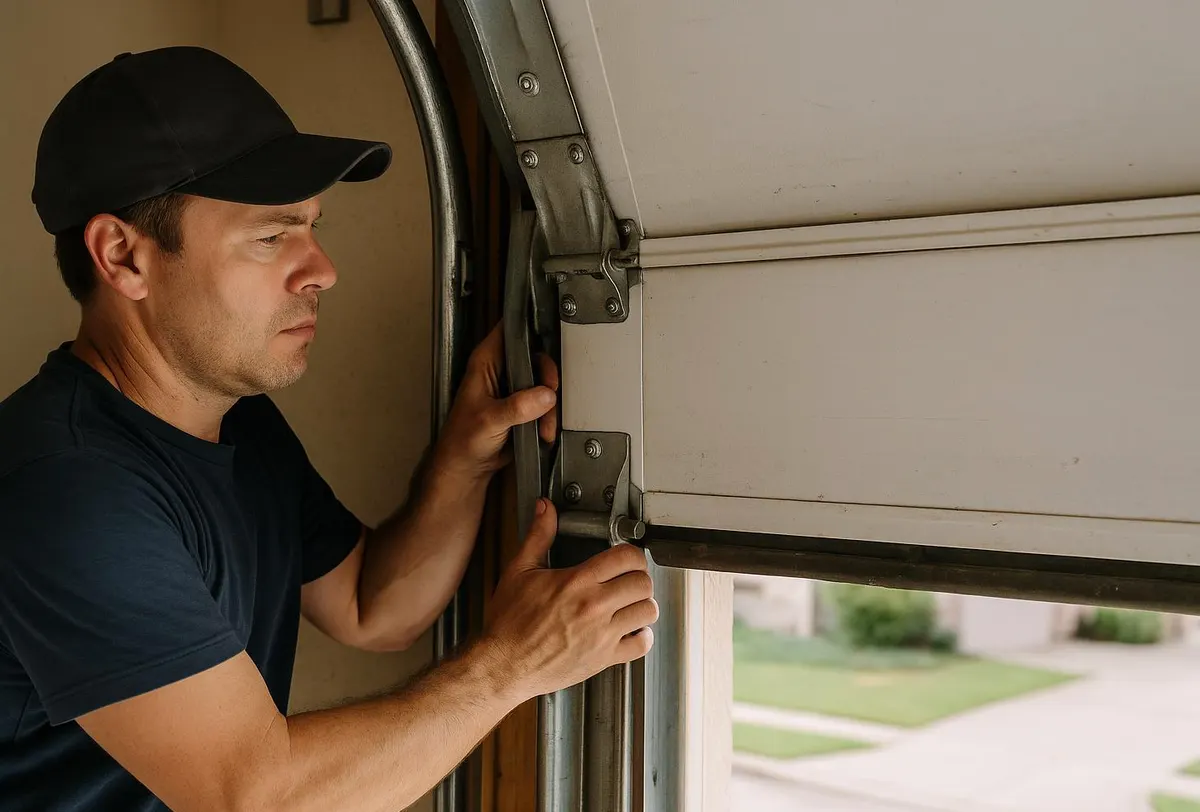
- Near a hinge or roller bracket — even a small dent here can throw the hinge out of alignment, which shows up as the door binding, jerking, or grinding in that spot every time it travels past
- On the vertical edge where panels meet the track — this is the stilebar, and a dent here can bend the roller stem or pull the roller slightly out of the track, which is often what's behind a door that looks like it's riding crooked
- Across a seam between two panel sections — if you can see the seam pulling apart or bulging instead of staying flush, the impact has stressed the fasteners holding sections together
- On or near the top or bottom reinforcement strut — these horizontal braces are part of what keeps a door rigid against wind pressure, and a bent strut is a different repair than a bent skin
If the dent lines up with any of these spots, the test isn't how it looks, it's how the door runs. Open and close it slowly and watch the track line, listen for a new grinding or clunking sound, and check whether the door seats evenly against the floor with no gap on one side. Any of those signs mean the dent reached past the surface and into the structure.
Why This Matters More Here Than in a Lot of Places
In this part of the Panhandle, garage doors aren't just there to look nice — the panels and the struts behind them are part of what keeps the door from failing under wind load during hurricane season storms. A dent at a strut or a hinge point doesn't just make noise, it can reduce the door's ability to hold up when wind pressure hits it hard. On top of that, a dent that creates a pocket or a seam gap gives humidity and afternoon rain somewhere to sit, and that's exactly how rust starts on steel doors, especially anywhere the paint has chipped at the impact point. If you've got a dent that's holding water or already showing a rust ring, that's a sign it's been there a while and needs attention regardless of whether it's structural.
A Quick Way to Settle It
Next time it comes up, walk out together and check three things: does the door open and close without any new sound or hesitation, is the dent touching a hinge, track, or strut, and is there any gap or separation at a seam. Smooth operation, flat-field location, tight seams — that's a cosmetic fix. Any binding, any hinge or track contact, any seam gap — that's a structural issue, and it's worth having someone look at it before the next storm tests it.
When to Call Youngstown Overhead Door Co
If the dent is near a hinge or track and the door isn't moving the way it used to, that's usually an alignment problem as much as a dent problem, and it's exactly what our Off Track Door Repair service is built to diagnose and fix. If a strut is bent or a panel section needs to be swapped out entirely rather than patched, we can handle that as part of a broader Garage Door Installation & Replacement job, replacing just the damaged section when that's enough, or the whole door when the dent is the least of its problems. Either way, we'll tell you straight which one it is instead of guessing from the driveway.
If you've got a dent you and your spouse can't agree on, give Youngstown Overhead Door Co a call. We serve Youngstown, Panama City, Lynn Haven, Fountain, Bonifay, Chipley, Marianna, and Callaway, and we'll settle the argument with a real look at the door, not a guess.