
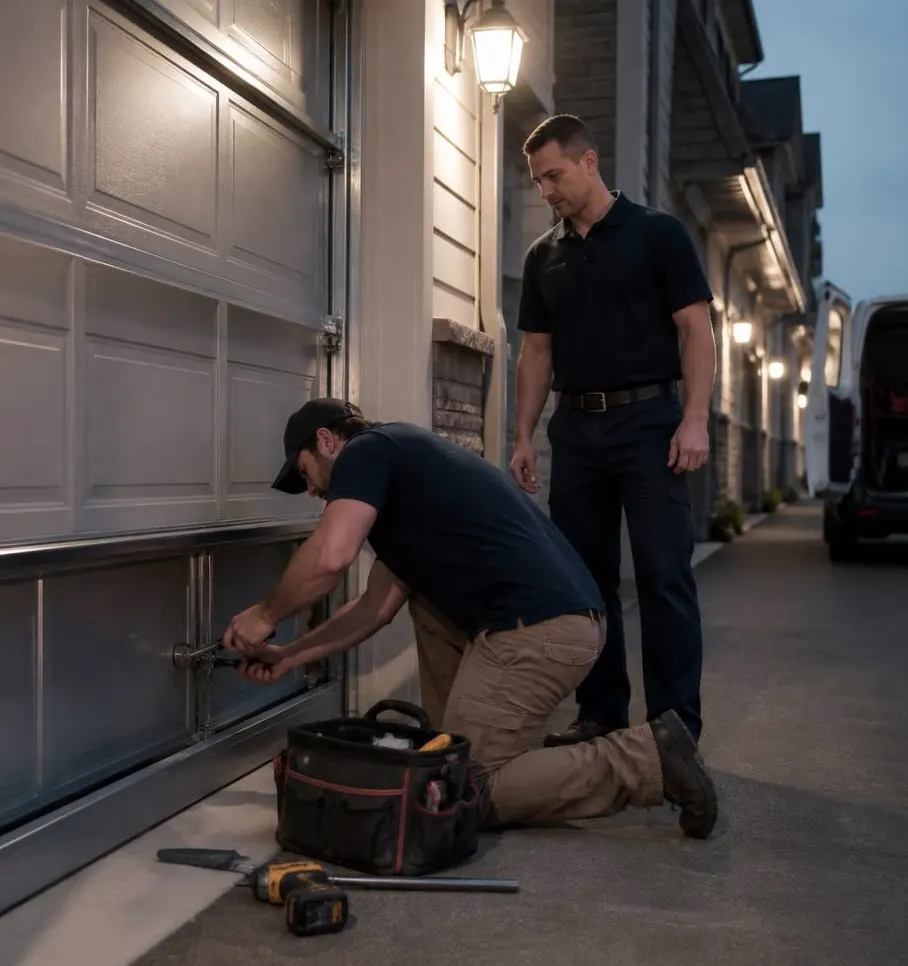
What a Typical Service Call Looks Like
The call usually starts the same way: the homeowner presses the remote, the door starts down, and a few inches or a couple feet from the floor it suddenly reverses and goes back up. Or the door won't move past a certain point at all, just sits there humming or clicking. Sometimes it closes fine in the morning and starts acting up by late afternoon, after the humidity has built or a storm has rolled through. By the time a technician gets there, the pattern usually points pretty clearly to one of a few spots, and we check them in roughly the same order every time because that's the order that actually finds the problem fastest.
The Symptoms We Hear Most
- Door reverses a few inches above the floor, every time
- Door reverses only partway down, inconsistently
- Door won't move at all when you press close, opener motor just hums
- Opener's light blinks a set number of times (a built-in error code on many models)
- Door closes fine with the wall button but not the remote, or vice versa
- Door seems to catch or jerk on one side before reversing
First Check: Safety Sensors (Photo Eyes)
These are the two small sensors mounted a few inches off the ground on either side of the track, and they're the single most common cause of a door that won't close or reverses for no obvious reason. If anything breaks the invisible beam between them, the opener treats it as an obstruction and sends the door back up, that's by design.
In this part of Florida, a few things interfere with that beam more than people expect. Morning condensation fogs the lenses after a humid night. Afternoon downpours splash mud and water onto the lower housings, especially on doors facing the driveway. Direct sun at a low angle can wash out the sensor's own indicator light enough that it misreads the beam. A technician checks the LED status lights on both sensors first, then wipes the lenses clean, checks that the brackets haven't drifted out of alignment, and inspects the wiring for pinches or chew marks, since moisture tends to draw in insects and small pests that can damage exposed low-voltage wire.
Second Check: Track Alignment and Obstructions
If the sensors check out clean, the next stop is the track itself. Wood door jambs and framing can swell slightly with seasonal humidity, which is enough to nudge a track out of true alignment over time. Storm debris, leaves, small branches, even wasp nests, can also lodge in the track and cause the door to bind partway through its travel. A technician runs a level along both tracks, looks for shiny wear marks that indicate the rollers are rubbing somewhere they shouldn't, and checks that the brackets holding the track to the frame are still tight.
Third Check: Close-Force and Limit Settings
Every opener has a setting that controls how much resistance it will push through before deciding something's in the way and reversing. If that setting is too sensitive, it doesn't take much, a slightly swollen panel, stiff weatherstripping, a bit of extra drag from humidity, to trigger a reversal that has nothing to do with an actual obstruction. This is a quick adjustment on most openers, dial-based on older units and menu-based on newer ones, but it has to be matched to the actual weight and balance of the door rather than just cranked up, or it stops protecting against real obstructions.
Fourth Check: Rollers and Cables
Worn or rusted rollers cause the door to catch slightly as it travels, and that catch can be enough to trip the force sensor or throw the door off track entirely. Closer to the coast, salt air accelerates this kind of corrosion on rollers, hinges, and cable ends well before they'd normally need attention. Frayed cables cause a similar problem, usually pulling the door unevenly to one side right before it reverses. The fix here is straightforward: clean and lubricate rollers that still have life left, replace ones that are pitted or flat-spotted, and swap out any cable showing fraying rather than waiting for it to fail completely.
Fifth Check: Spring Tension
If the door feels heavy when operated manually, or the opener strains audibly before reversing, the springs are usually losing tension. A properly balanced door should lift with moderate hand pressure; if it doesn't, the opener is doing extra work it wasn't designed for, and it can't always tell the difference between that extra resistance and a real obstruction. Humidity and salt exposure both shorten spring life over time. Spring replacement involves releasing the existing tension safely, installing new springs rated for the door's weight, and resetting the balance, not a job to attempt without the right bars and clamps, since torsion springs store a serious amount of force.
Sixth Check: Opener Logic Board or Wiring
If everything mechanical checks out, the remaining possibility is the opener's circuit board or internal wiring. Power surges from hurricane-season storms and nearby lightning strikes can damage these boards in ways that show up as erratic behavior rather than total failure, the door might work fine for days, then start reversing randomly. A technician tests the board's response to the sensors and controls directly to isolate this from everything upstream.
When to Call Youngstown Overhead Door Co
If you've cleaned the sensor lenses and the door still won't close reliably, or if it feels heavy, noisy, or off-balance when you lift it by hand, it's time to get a technician out rather than keep adjusting force settings yourself. Our Off Track Door Repair and Garage Door Spring Repair services cover most of what causes this exact problem, and a Garage Door Maintenance & Tune-Up catches rust, worn rollers, and sensor drift before they turn into a door that won't close at all, especially useful heading into storm season.
If your garage door is reversing, sticking, or refusing to close, call Youngstown Overhead Door Co for a straightforward diagnosis and repair, serving Youngstown, FL and the surrounding Bay County area.